Performance Optimization of Waste Bank and TPS 3R in Jambi City
Keywords:
recovery rate, recycling rate, SWOT, TPS3R, waste bankAbstract
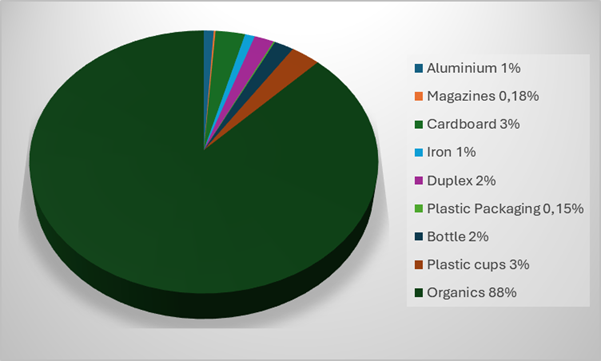
In Indonesia, there are two kinds of waste recycling site: waste bank (managed by community) and TPS3R (managed by government). Jambi City has 12 active waste banks and 9 TPS3R established to overcome the increasing waste generation every year. This study aims to analyze the amount of waste generation along with the composition, recycling rate, and recovery rate of waste in the waste bank and TPS3R. In addition, determination of the direct economic benefits and the SWOT analysis are being carried out to determine suitable strategies to optimize the two waste recycling sites. The study result shows the amount of waste generated in the waste bank averagely 37419.15 kg/month with the composition mostly iron material with an amount of 8119 kg/month. Waste generation in Jambi City TPS3R is 107,592.7 kg/month and the highest composition is organic waste with an amount of 94,244.7 kg/month. Recycling rate and recovery rate in the Jambi City Waste Bank whose value is equal to 0,268%. The value of the recycling rate and recovery rate of TPS3R in Jambi City is 0.096% and 0.770%. The economic benefits or benefits obtained are based on the value of benefit to cost ratio (B/C) in the Jambi City Waste Bank, which is less than 1, which means that the activity does not provide benefits or is not financially feasible, while for Jambi City TPS3R shows that the B/C value is greater than 1, meaning the activity provides benefits and is financially feasible. The SWOT analysis resulting in nine waste banks and eight TPS3R in Jambi City suggested on S-O strategy to optimize the management. Meanwhile, three waste banks and one TPS3R recommended on W-O strategy to optimize the management.
References
Ariefahnoor, D., Hasanah, N. & Surya, A., 2020. Pengelolaan sampah Desa Gudang Tengah melalui manajemen bank sampah. Jurnal Kacapuri: Jurnal Keilmuan Teknik Sipil, 3(1), pp.14–30. Available at: http://dx.doi.org/10.31602/jk.v3i1.3594.
Aryenti, 2011. Peningkatan peranserta masyarakat melalui gerakan menabung pada bank sampah di Kelurahan Babakan Surabaya, Klaracondong Bandung. Jurnal Pemukiman, 6(1), pp.40–46.
Auliani, R., 2020. Peran bank sampah induk dalam pengelolaan sampah Kota Medan. Jurnal Abdidas, 1(5), pp.330–338. Available at: https://doi.org/10.31004/abdidas.v1i5.80.
Bongers, A. & Casas, P., 2022. The circular economy and the optimal recycling rate: A macroeconomic approach. Ecological Economics, 199, p.107504.
Damanhuri, E., 2004. Diktat Kuliah TL-3150 Pengelolaan Persampahan. Bandung: Institut Teknologi Bandung.
Damanhuri, E., 2010. Diktat Kuliah TL-3104 Pengelolaan Sampah. Bandung: Institut Teknologi Bandung.
Departemen Pekerjaan Umum, 1999. Tentang Sampah Sebagai Sumber Daya. Jakarta: Departemen Pekerjaan Umum.
EPA, 1994. Waste Prevention, Recycling, and Composting Options: Lessons from 30 US Communities. Washington, D.C.: United States Environmental Protection Agency.
Peraturan Daerah Kota Jambi Nomor 8 Tahun 2013. Tentang Pengelolaan Sampah. Pemerintah Kota Jambi.
Peraturan Menteri Lingkungan Hidup Nomor 13 Tahun 2012. Pedoman Pelaksanaan Reduce, Reuse dan Recycle melalui Bank Sampah. Kementerian Lingkungan Hidup Republik Indonesia.
Peraturan Menteri Pekerjaan Umum Nomor 03 Tahun 2013. Penyelenggaraan Prasarana dan Sarana Persampahan dalam Penanganan Sampah Rumah Tangga dan Sampah Sejenis Sampah Rumah Tangga. Kementerian Pekerjaan Umum Republik Indonesia.
Peraturan Pemerintah Nomor 81 Tahun 2012. Tentang Pengelolaan Sampah Rumah Tangga dan Sampah Sejenis Sampah Rumah Tangga. Pemerintah Republik Indonesia.
Putra, W.T., 2020. Pemberdayaan masyarakat melalui pengelolaan sampah di bank sampah. Jambura Journal of Community Empowerment, pp.69–78. Available at: https://doi.org/10.37411/jjce.v1i2.569.
Putri, P.A., Mutmainnah, E., Ramadhani, P.A., Viareco, H. & Hutagalung, W.L.C., 2024. Sampah & Solusinya: Memahami Berbagai Metode Pengolahan. Yogyakarta: EDU Publisher.
SNI 19-7030-2004. Spesifikasi Kompos dari Sampah Organik Domestik. Badan Standardisasi Nasional.
Start, D. & Hovland, I., 2004. Tools for Policy Impact: A Handbook for Researchers. London: Overseas Development Institute.
Sugiyono, 2005. Metode Penelitian Administrasi. Bandung: Alfabeta.
Suryani, A.S., 2014. Peran bank sampah dalam efektivitas pengelolaan sampah (studi kasus Kota Malang). Jurnal Aspirasi, 5(1), pp.72–75.
Tchobanoglous, G., 1993. Integrated Solid Waste Management. New York: McGraw-Hill.
Undang-Undang Nomor 18 Tahun 2008. Tentang Pengelolaan Sampah. Pemerintah Republik Indonesia.
Vincent, 2013. Analysis and optimization of waste bank and material recovery facility performance in solid waste management at Beji Subdistrict City of Depok. Analisis dan Optimasi Kinerja Bank Sampah dan Unit Bank Sampah (UPS) dalam Pengelolaan Sampah di Kelurahan Beji Depok. [Skripsi] Jakarta: Universitas Indonesia.
Widyawati, R., Rinaldi & Hutagalung, W.L.C., 2020. Analisis timbulan dan komposisi sampah untuk potensi reduksi sampah di Kelurahan Selamat. Jurnal Engineering, 2(2), pp.86–95.
Downloads
Published
Issue
Section
License
Copyright (c) 2025 Winny Laura, Anggun Permatasari, Rinaldi

This work is licensed under a Creative Commons Attribution-NonCommercial-ShareAlike 4.0 International License.